







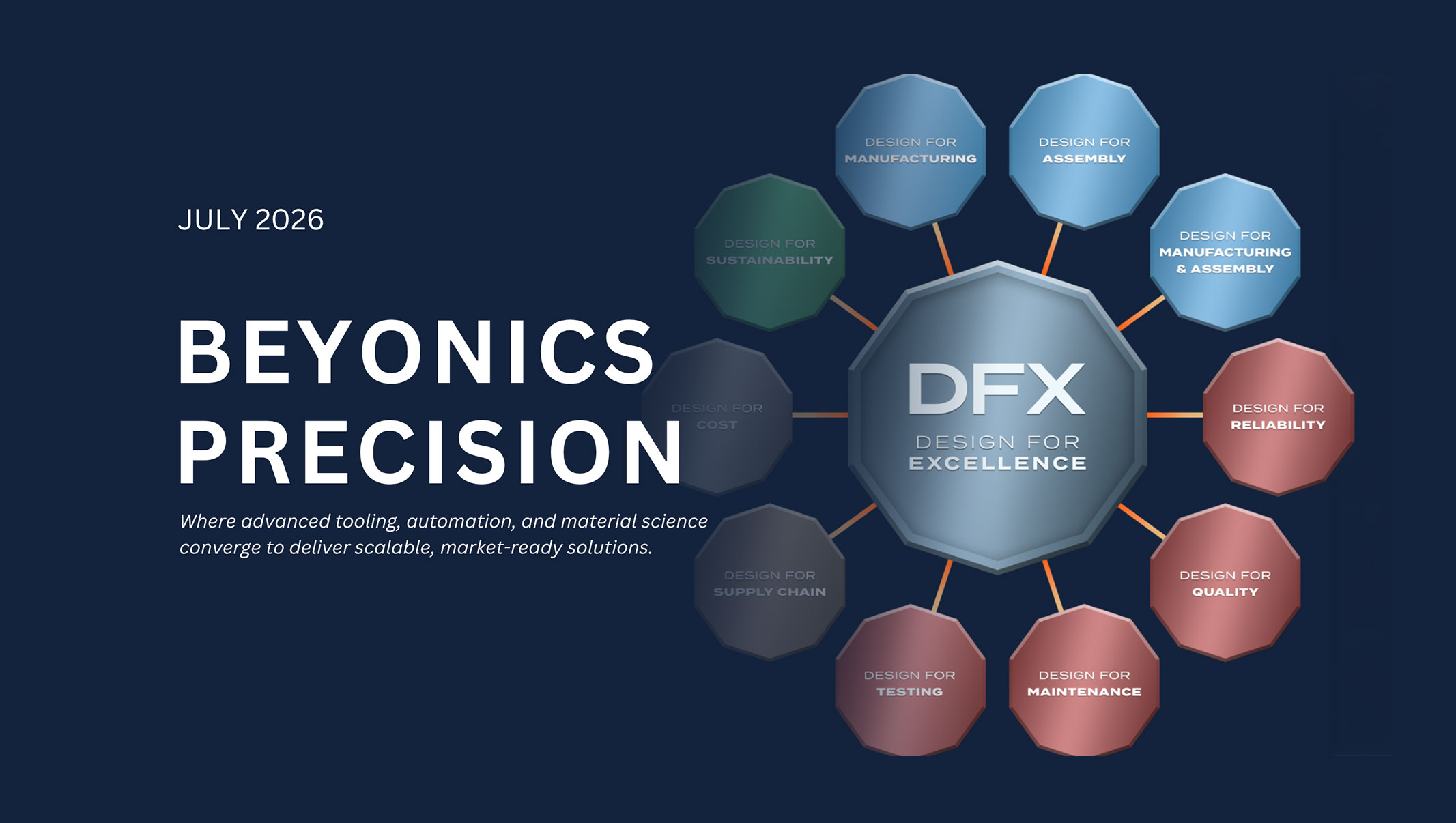

In our Design for Excellence (DFX) series, we’ve explored how early design decisions impact cost, manufacturability, assembly, reliability, and testability. This month, we address Design for Supply Chain (DFSC) and Design for Cost (DFC): the disciplines of building resilience and optimizing total landed cost through intelligent design decisions.
With supply chain disruptions costing companies an estimated 30-50% of annual EBITDA per major event, according to McKinsey & Company research, resilience is no longer a procurement concern – it is a design imperative.
The future of product development is collaborative. The future is DFX.
Why supply chain and cost must be designed in, not managed around
Design for Supply Chain asks: Can this product be sourced reliably, at scale, and with minimal exposure to disruption? Design for Cost asks: Can we optimize total landed cost without compromising quality or performance?
The two disciplines are interdependent. A component selected solely for its low piece price may carry hidden costs – extended lead times, single-source dependencies, logistics complexity, or exposure to geopolitical risks. A design that relies on exotic materials or niche laminates may be technically sound, but it narrows the available supply base and creates vulnerability.
In today’s environment – where copper prices fluctuate, resin systems tighten, and lead times stretch unpredictably – supply stability is largely determined at the design stage. The most effective DFSC/DFC approach results in multi-sourced components, design flexibility for material substitution, streamlined supply chains, and total cost visibility – not just piece price.
The Beyonics Perspective
True Design for Supply Chain and Cost isn’t an afterthought. It is integrated from the earliest design discussions. Our vertically integrated capabilities – in-house tooling, aluminum die casting, insert molding, surface treatment, FIP gasketing, precision bonding, and multi-material assembly – enable a “one-team” approach that eliminates handoff gaps and reduces logistics costs.
When supply chain architects and design engineers collaborate early, they can:
Reduce part count and simplify supplier coordination
Optimize part geometry for both die-casting and injection molding processes before tooling release
Design mating surfaces and alignment features to ensure repeatable assembly
Validate electrical connector alignment and mating force requirements through prototyping
Lower total program cost and timeline by preventing expensive tooling changes and launch delays
Case in Point: ADAS Housing – From Fragmented Supply to Integrated Efficiency
The challenge: A leading global Tier-1 automotive supplier faced a critical program risk. They needed an integrated housing solution for next-generation radar and camera systems – but conventional manufacturing approaches had already created alignment issues, assembly complexity, and commercialization delays.
The program required a partner who could de-risk the entire process, not just produce parts. Coordinating multiple suppliers across different regions had introduced logistics overhead, coordination delays, and exposure to supply chain risks.
The manufacturing requirements included:
- Long-term reliability for unattended operation in critical infrastructure environments
- Consistent energy harvesting performance across millions of insertion cycles
- Encrypted authentication security (AES-256) with resistance to credential copying
- Environmental durability – temperature extremes, moisture, dust, corrosion, freeze-thaw cycling
- Power-outage resilience – full functionality without grid power
- Integration of 100+ existing parts into a streamlined, cost-effective assembly
Beyonics Contribution
Beyonics delivered a vertically integrated manufacturing solution combined with deep early-stage collaboration. By taking ownership of the full manufacturing chain – from aluminum die casting, insert molding, CNC machining, surface treatment, FIP EMI gasket application, to precision bonding – Beyonics eliminated the gaps that typically arise between design, prototyping, and mass production.
This vertically integrated approach transformed a fragmented multi-supplier process into a single, repeatable workflow – eliminating handoff delays, simplifying supplier coordination, and accelerating start-of-production.
The Outcome
Reduced program risk – eliminated the gaps between multiple suppliers
Accelerated time-to-market – reduced handoff delays and simplified program management
Optimized supply chain – reducing part count and simplifying supplier coordination
Lower total program cost – prevented expensive tooling changes and launch delays through early collaboration
Production-ready system – validated to IATF 16949 automotive quality standards

By consolidating the manufacturing chain and simplifying supplier coordination, our customer achieved a production-ready ADAS housing that met all performance requirements while maintaining cost competitiveness – demonstrating the power of designing for supply chain and cost from the start.