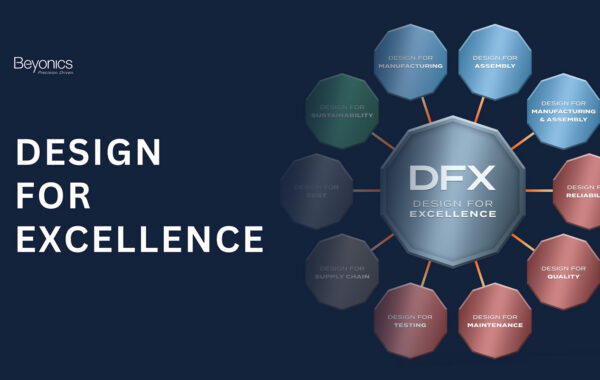







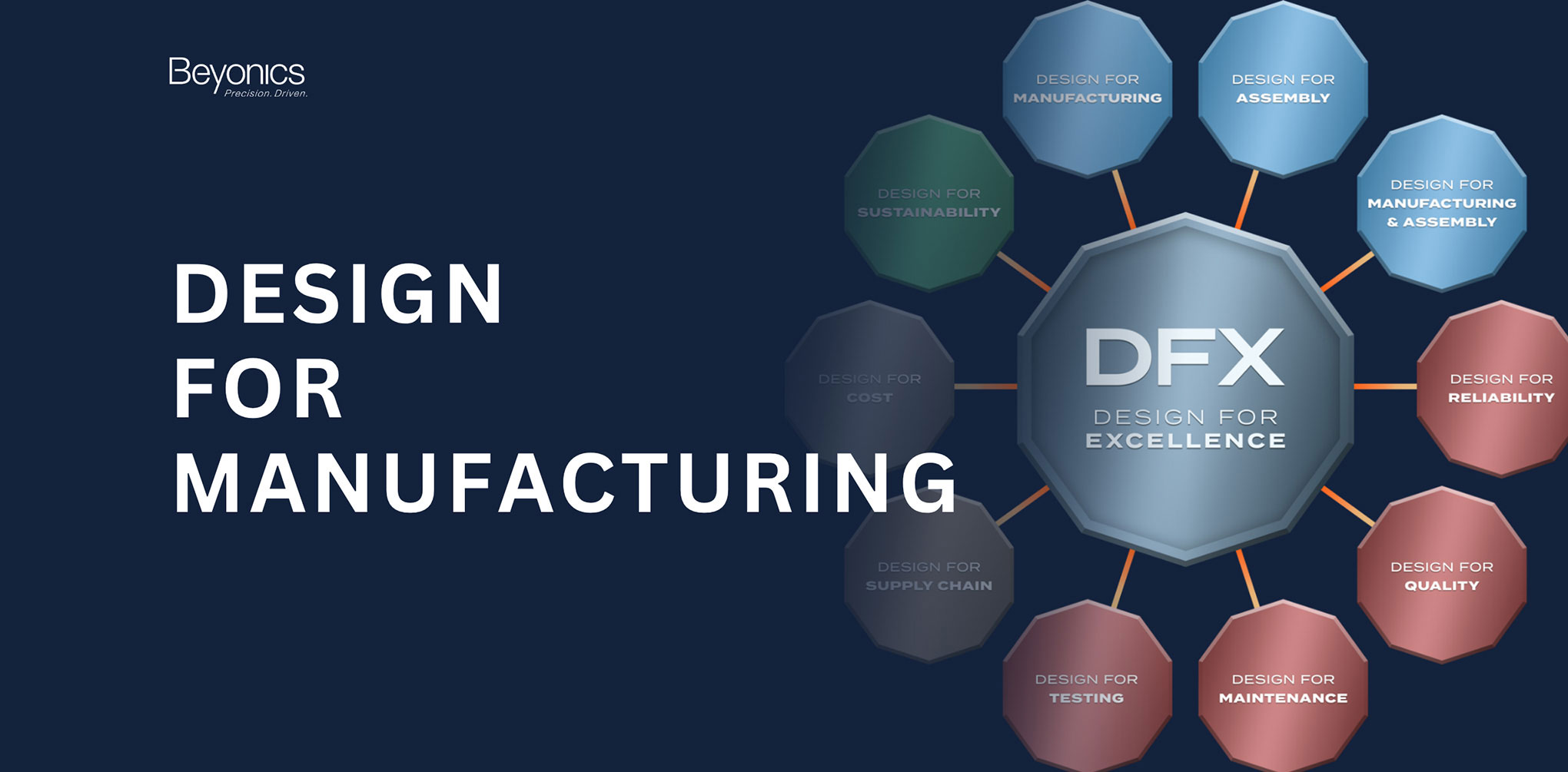

Welcome to the second installment of our multi-part series on Design for Excellence (DFX). In our first article, we explored the 70% rule—how upstream design decisions determine 70-80% of a product’s final cost, quality, and manufacturability. We illustrated this through our work supporting a complex spinal surgical device, where early collaboration on tooling design and process validation proved essential to our customer’s commercial success.
This month, we turn to Design for Manufacturing (DFM): the practical bridge between innovation and execution. In precision engineering serving MedTech, Mobility, and SmartTech markets, DFM challenges center on geometry, material selection, process capability, and the complex interactions between multiple manufacturing disciplines.
The future of product development is collaborative. The future is DFX.
Bridging the gap between ideal geometry and producible reality
Design for Manufacturing is the disciplined practice of asking: Can we build this reliably, repeatedly, and cost-effectively, given the laws of physics and the realities of the factory floor? For Tier-1 automotive suppliers developing ADAS systems, the margin between program success and failure isn’t measured in profit—it’s measured in precision. When a safety-critical component fails to perform, the consequences cascade: delayed launches, fractured OEM relationships, and warranty exposure.
A design that excels purely on functionality, without considering how molten material flows in a complex mold, how multiple materials bond under thermal stress, or how micro-level tolerances are achieved and verified, is destined for costly delays and rework. The most effective DFM process is a dialogue between design intent and manufacturing reality.
The Beyonics Perspective
True Design for Manufacturing isn’t a checklist applied after tooling is ordered. It is a collaborative discipline integrated from the start—and a strategic enabler of program success. Our experience serving MedTech, Mobility and SmartTech leaders demonstrates that the most successful programs emerge when engineering teams invite manufacturing expertise to the table before design lock.
Case in Point: Supporting an Integrated Housing for Radar and Camera System
A leading Tier-1 automotive supplier needed an integrated housing solution for next-generation radar and camera systems. Conventional manufacturing approaches had created alignment issues, assembly complexity, and commercialization delays. They required a partner who could de-risk the entire process, not just produce parts.
Beyonics delivered a vertically integrated manufacturing solution combined with deep early-stage collaboration. By taking ownership of the full manufacturing chain, we eliminated the gaps that typically arise between design, prototyping, and mass production.
Key manufacturing requirements included:
- Precision die-cast and machined housing with dimensional stability
- Integration of casting, insert molding, powder coating, bonding, and gasketing
- Form-in-Place (FIP) sealing with EMI/RFI protection for sensitive electronics
- IATF 16949 automotive quality standards for safety-critical applications
Beyonics Contribution
Our vertically integrated capabilities—in-house tooling, automation, materials expertise, and R&D resources—enabled a “one team” approach. Early DFM collaboration helped optimize part geometry, design mating surfaces, and validate connector alignment before tooling release.
The Core Insight
This engagement illustrates a fundamental principle of DFM: complexity multiplies, it does not simply add. When a single assembly must integrate die-cast metal, insert-molded electronics, dispensed seals, and bonded components, the interactions between processes become as critical as the processes themselves. A casting dimension that shifts during cooling affects insert molding fit. A dispensed bead’s consistency impacts seal integrity. Bonding strength depends on surface preparation from previous operations. These interdependencies cannot be discovered during production ramp—they must be anticipated during design.
When customers invite their manufacturing partner into the conversation early, they gain access not only to production capacity but to decades of process engineering experience across multiple disciplines and industries. In automotive, where safety-critical systems demand zero defects and production volumes require absolute process stability, DFM is not a luxury. It is a competitive necessity.