






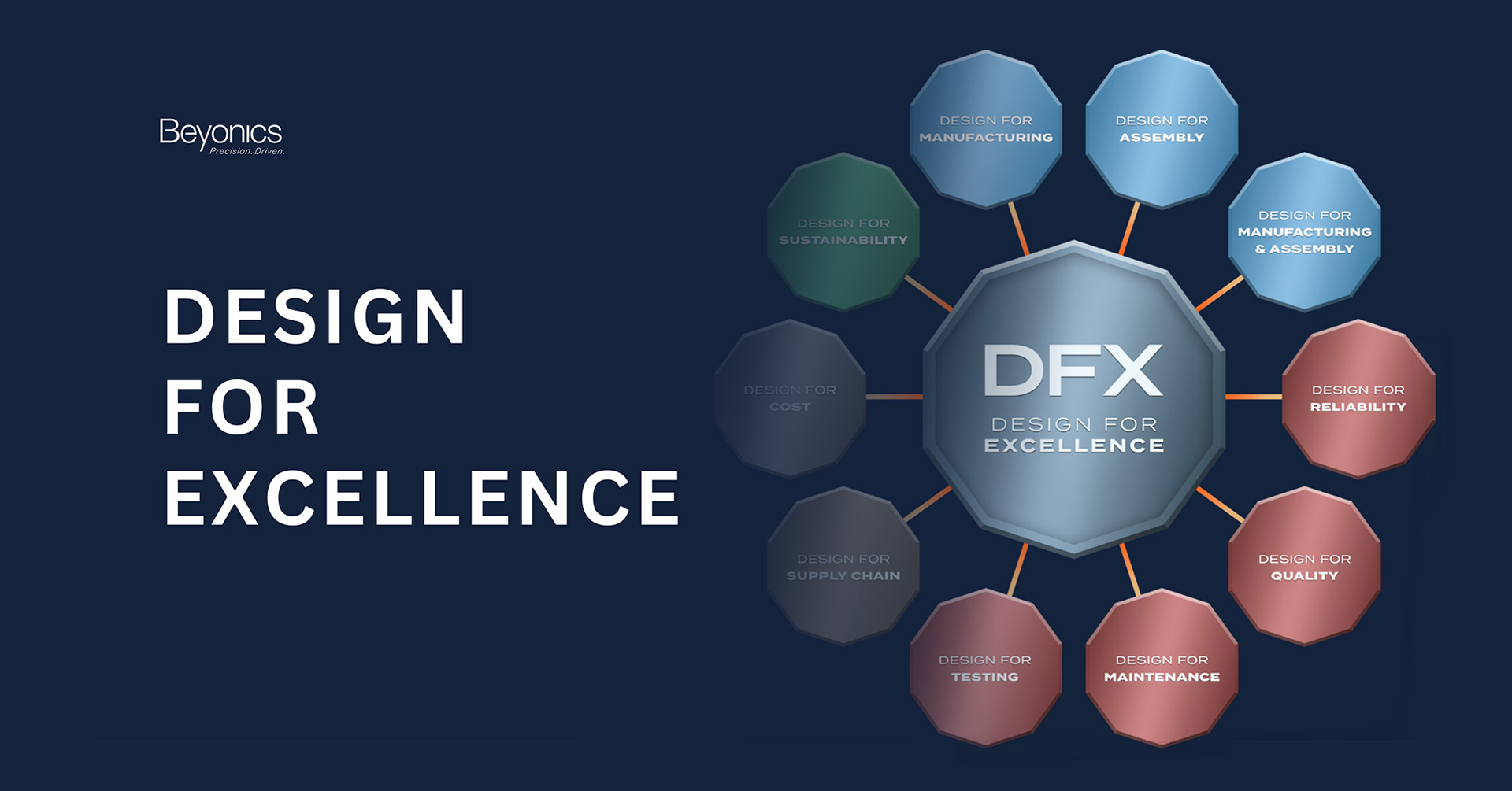

Welcome to the final installment of our multi-part series on Design for Excellence (DFX).
Over the past five articles, we have explored the principles and disciplines that shape a successful product long before it reaches production—from the 70% rule and Design for Manufacturing (DFM) to Design for Assembly (DFA), Design for Reliability & Testability (DFR & DFT), and Design for Supply Chain & Cost (DFSC & DFC).
Each discipline addresses a different aspect of product development. But their greatest value comes when they are applied together.
In this final article, we bring the series together to examine DFX as an integrated approach to product development—one that moves teams away from siloed, reactive problem-solving and toward earlier, more collaborative decision-making.
The future of product development is collaborative. The future is DFX.
Beyond the Sum of Its Parts: What Makes DFX Work
Design for Excellence is built on a simple but powerful premise: it is far more effective to address potential issues during design than to discover and correct them later in development, production, or the field.
This principle is reflected in the widely recognized relationship between design decisions and product economics. While the design phase may represent only a relatively small portion of total product expenditure, many of the decisions made during this stage influence a significant share of the product’s eventual cost, quality, manufacturability, and lifecycle performance.
DFX is therefore not a single tool or checklist. It is a systematic, cross-functional methodology that brings together expertise from across the product lifecycle and applies it during the design process.
Its purpose is to move organizations beyond a traditional design-build-test-fix approach toward one that identifies and addresses potential issues before they become costly changes.
The key is integration.
Rather than allowing mechanical design, electronics, manufacturing, quality, reliability, testing, procurement, and supply chain planning to operate independently, DFX encourages these functions to contribute their expertise in parallel and at the earliest practical stages of development.
The result is a product designed not only to function, but also to be manufactured, assembled, tested, validated, sourced, and scaled effectively.
The Beyonics Perspective: Earlier Collaboration, Better Outcomes
At Beyonics, our experience supporting programs across MedTech, Mobility, and SmartTech has consistently reinforced one principle: early collaboration between design and manufacturing teams creates more opportunities to improve the final product.
When manufacturing expertise is introduced before key design decisions are locked, teams can evaluate potential trade-offs across materials, processes, assembly, testing, reliability, sourcing, and cost while changes are still easier to make.
The benefits can include:
- Fewer costly redesigns – because manufacturability, assembly, reliability, and testability are considered earlier in the development process
- Faster time-to-market – because potential manufacturing and supply chain issues can be identified before they affect later development stages
- Lower total cost – through optimization of part count, materials, manufacturing processes, supplier coordination, and logistics
- Improved quality and reliability – because validation requirements and potential failure modes are considered as part of the design process, rather than addressed only after problems emerge
- Greater supply chain resilience and flexibility – with manufacturing capabilities across Singapore, Malaysia, Thailand, and China, giving customers alternative sourcing options and greater flexibility to manage capacity, regional requirements, and supply chain risk
Early engagement doesn’t just help solve manufacturing problems. It creates an opportunity to design those problems out before they occur.
Bringing It Together: The Integrated DFX Framework
Throughout this series, we have examined individual DFX disciplines. But in practice, these disciplines are closely connected.
A decision made in one area can create benefits—or unintended consequences—in another. That is why DFX is most effective when each discipline is considered as part of an integrated framework.
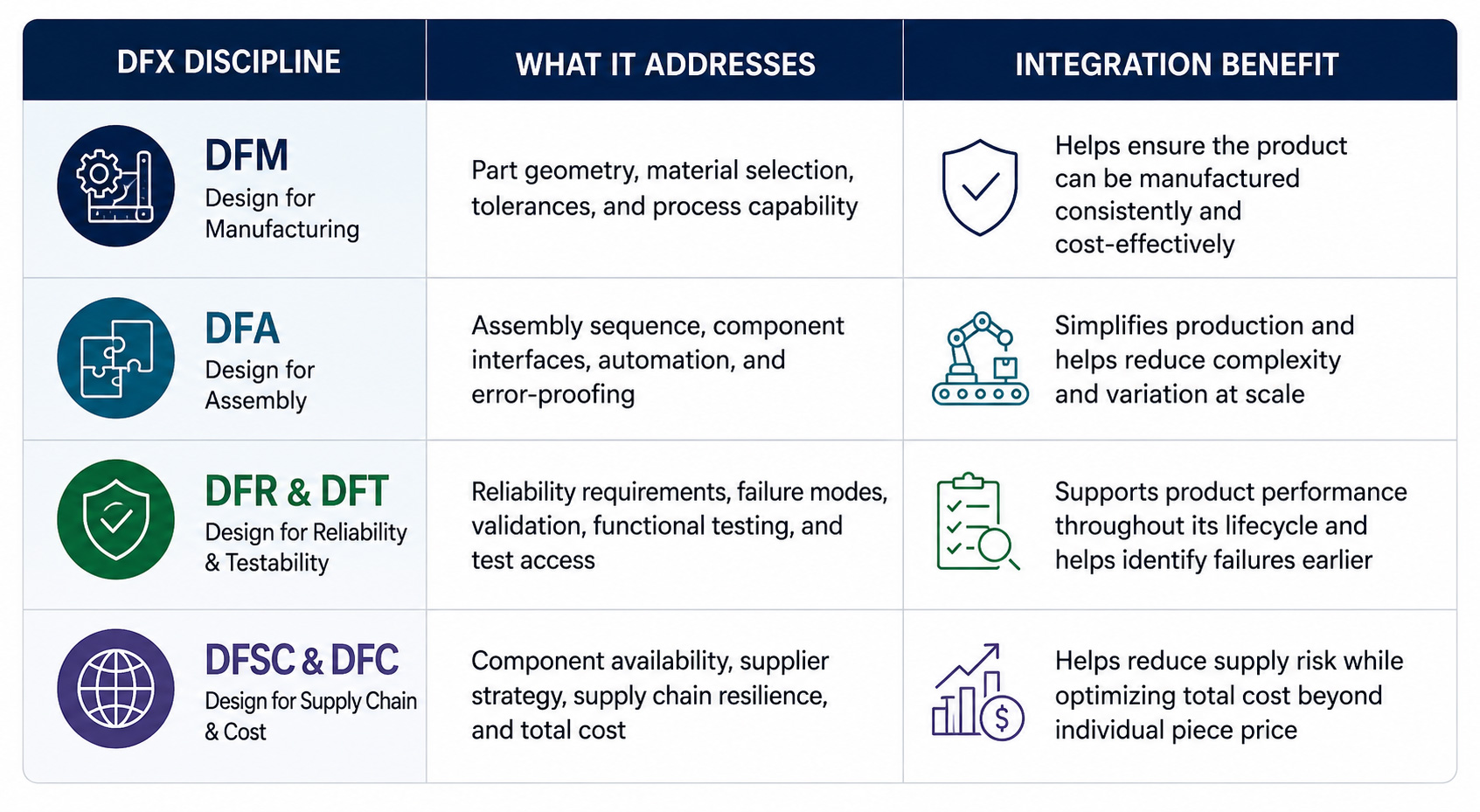
Consider a simple example: a change made to simplify part geometry for manufacturability may also reduce assembly steps, lower material usage, eliminate potential failure points, and simplify sourcing.
A single design decision can therefore influence DFM, DFA, DFR, DFT, DFSC, and DFC simultaneously.
These interdependencies are where the real value of integrated DFX lies.
When these disciplines work together, the result is a product designed not simply to meet specifications, but to perform effectively across development, production, and its entire operational lifecycle.
This principle has been reflected throughout the examples explored in this series—from spinal surgical devices and CGM devices to ADAS housings and smart locking systems.
Vertical Integration: DFX in Action
Integrated DFX requires more than identifying potential issues. It requires understanding how design decisions affect downstream manufacturing processes and bringing the right expertise into the conversation at the right time.
At Beyonics, our vertically integrated capabilities—precision tooling, plastic injection molding (including insert, overmolding, and 2K), cleanroom molding, high-density PCBA, and high-speed automated assembly—enable us to implement DFX holistically.
This breadth of capability enables our engineering and manufacturing teams to evaluate design decisions across multiple processes rather than optimizing each process in isolation.
- Reduce handoff gaps by improving continuity between different stages of product development and manufacturing
- Simplify supplier coordination by integrating multiple manufacturing processes within a single operating platform
- Optimize the overall manufacturing flow, rather than focusing only on individual components or processes
- Accelerate the transition from design to production through closer collaboration between engineering, tooling, manufacturing, quality, and assembly teams
Vertical integration is therefore more than a manufacturing model. It can enable a more connected DFX approach.
When engineering insight and manufacturing capability are closely linked, design decisions can be evaluated earlier and more comprehensively against real-world process requirements.
Design for Excellence: Turning Early Decisions into Competitive Advantage
In increasingly complex markets, designing a product that simply meets its functional requirements is no longer enough. Products must also be manufacturable at scale, reliable, testable, cost-effective, and supported by resilient supply chains.
This is where DFX becomes a competitive advantage. By embedding lifecycle considerations into the design process, companies can reduce avoidable complexity and align product requirements more closely with manufacturing realities—supporting higher quality, faster time-to-market, greater reliability, and better cost and supply chain performance.
It brings us back to where this series began: the 70% rule. Many of the decisions that shape a product’s cost, quality, and performance are made long before production begins.
That is not a constraint. It is an opportunity.
An opportunity to bring manufacturing expertise into the conversation earlier, challenge unnecessary complexity before it becomes embedded in the design, and consider manufacturing, assembly, reliability, testing, supply chain, and cost as interconnected design considerations—not downstream problems.