







Home » Design for Reliability & Testability: Building Confidence in High-Stakes Environments
In our first article, we explored the 70% rule – how upstream design decisions determine 70-80% of a product’s final cost, quality, and manufacturability through our work supporting a complex spinal surgical device. In our second article, we examined Design for Manufacturing (DFM) through the lens of an ADAS radar and camera housing, where early collaboration on tooling and process validation proved essential. In our third article, we focused on Design for Assembly (DFA) through our work on a Continuous Glucose Monitoring (CGM) device, demonstrating how intelligent assembly planning enables high-volume production.
This month, we turn to Design for Reliability (DFR) and Design for Testability (DFT): the complementary disciplines of ensuring products perform as intended over their full lifecycle – and verifying that performance through repeatable, scalable testing.
In SmartTech applications – where security systems must operate without failure for years, often in critical infrastructure or unattended environments – reliability is not a feature. It is a fundamental requirement.
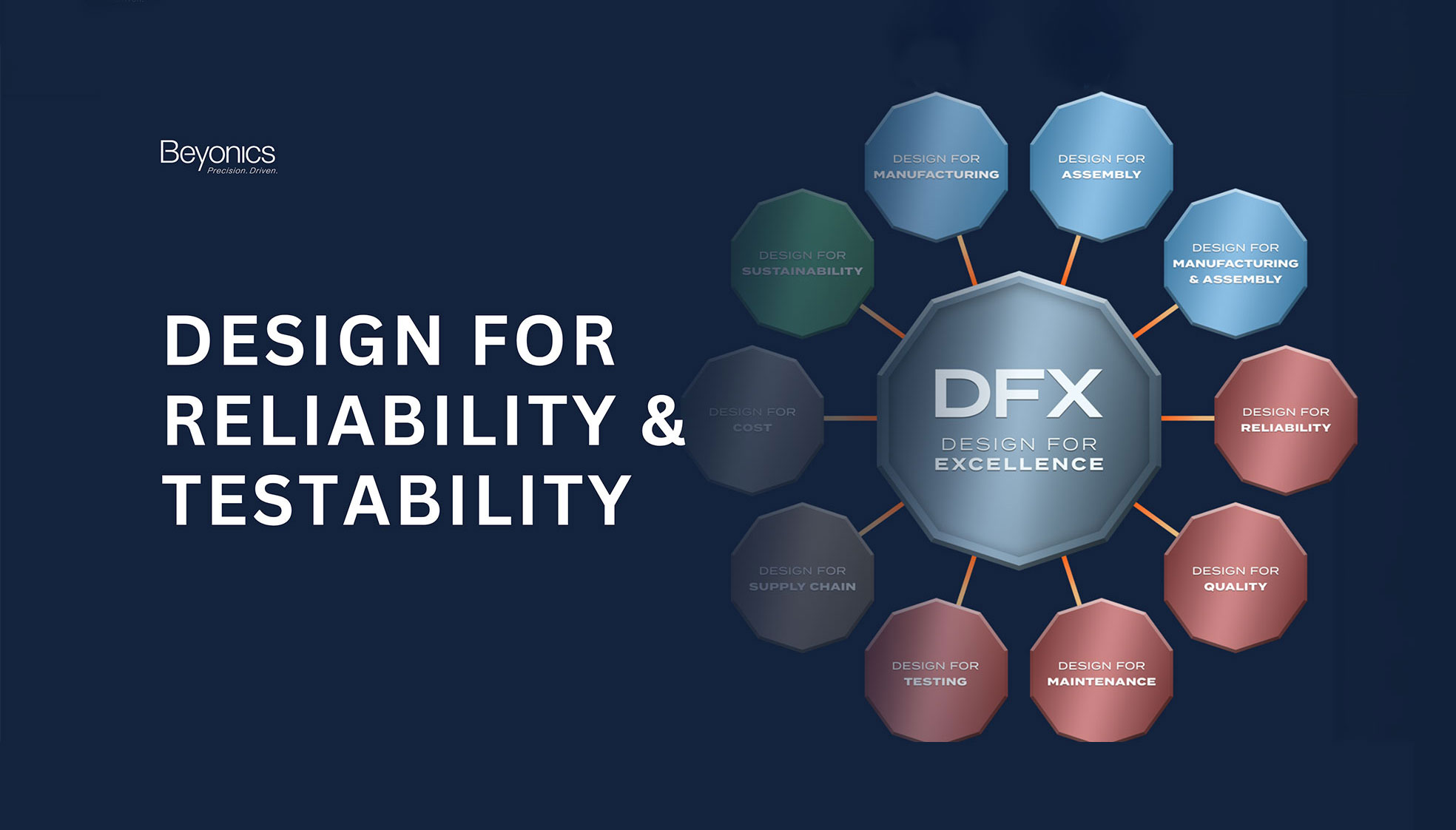
The future of product development is collaborative. The future is DFX.
Why reliability and testability must be designed in, not inspected in
Design for Reliability asks: Can this product withstand real-world conditions – temperature extremes, humidity, vibration, power fluctuations, and years of continuous operation? Design for Testability asks: Can we verify every critical function efficiently and repeatedly, without slowing production?
The two disciplines are inseparable. A design that cannot be tested effectively is a design prone to hidden failures. A design that has not been validated for real-world conditions will fail in the field – eroding user trust, increasing warranty costs, and damaging brand reputation.
In regulated industries like MedTech and Mobility, DFR and DFT are backed by formal standards such as ISO 13485 (medical devices) and IATF 16949 (automotive). In SmartTech, where products often operate without direct supervision, the same principles apply: reliability must be engineered from the start.
The most effective DFR/DFT approach results in validated designs, built-in test points, automated functional testing, and processes that catch failures early – before they reach the customer.
The Beyonics Perspective
True Design for Reliability and Testability isn’t an afterthought. It is integrated from the earliest manufacturing discussions. Our experience serving MedTech, Mobility, and SmartTech leaders demonstrates that the most successful programs build validation and testing into the manufacturing process – not as a final gate, but as a continuous thread from prototype through production.
Case in Point: Battery-Free Smart Locking System
Critical infrastructure operators – including telecommunications towers, utility networks, transportation systems, and water treatment facilities – require secure, reliable access control that can operate for years without maintenance in harsh outdoor environments.
Our work with a European pioneer in digital locking technology involved the manufacturing of a battery-free, energy-harvesting electronic lock. Unlike conventional electronic locks that require batteries or wired power, this system generates the energy needed for authentication and unlocking directly from the kinetic motion of inserting a key into the lock cylinder – with no batteries in the lock, no batteries in the key, and no dependency on Wi-Fi or internet connectivity for basic operation.
The lock performs electronic authentication and access-rights verification using AES-256-encrypted communication between the key and the cylinder, with resistance to credential copying and secure digital credential management. This unique energy-harvesting architecture means every authentication event depends on real-time power generation from a mechanical act, making manufacturing precision and long-term mechanical reliability mission-critical.
The device must perform reliably in unattended outdoor locations, demanding resistance to temperature extremes, moisture, dust, corrosion, and physical tampering – while housing sensitive electronics and encrypted authentication components.
The manufacturing requirements included:
- Long-term reliability for unattended operation in critical infrastructure environments
- Consistent energy harvesting performance across millions of insertion cycles
- Encrypted authentication security (AES-256) with resistance to credential copying
- Environmental durability – temperature extremes, moisture, dust, corrosion, freeze-thaw cycling
- Power-outage resilience – full functionality without grid power
- Integration of 100+ existing parts into a streamlined, cost-effective assembly
Beyonics Contribution
Beyonics partnered with the customer as a true engineering and manufacturing partner. By collaborating closely from the earliest stages, we translated innovative energy-harvesting technology into a manufacturable, production-ready system.
Our contributions included:
Precision Mold Design & Fabrication: Developing precision tooling for complex plastic geometries requiring sub-millimeter tolerances to ensure consistent energy harvesting performance across millions of cycles.
In-Mold Electronics (IME): Encapsulating sensitive NFC and electronic components within molded parts while maintaining full post-molding functionality – requiring careful material selection, precise control of molding temperature and pressure, and tooling designed to minimize stress on embedded components.
High-Density PCBA: Manufacturing printed circuit board assemblies with built-in test points to enable functional verification of authentication and encryption during production.
Insert Molding: Producing smart key components with insert molding for durability and reliable electrical contact.
Full Product Assembly Line: Designing and building a complete assembly line incorporating automated functional testing at key stages – including NFC communication verification and energy harvesting validation.
Vertical Integration & Cost Optimization: Reviewing over 100 existing parts to identify consolidation opportunities, shortening the supply chain, and lowering overall production costs.
When customers invite their manufacturing partner into the conversation early, they gain access not only to production capacity but to deep expertise in testability planning, process validation, and long-term reliability. For a battery-free locking system – where every authentication event depends on precise mechanical-to-electrical energy conversion – manufacturing precision is not just about fit and finish. It is about the reliable generation of power from a mechanical act.
In SmartTech, where security systems must operate flawlessly for years without intervention in critical infrastructure environments, DFR and DFT are not optional – they are essential.
Validated designs and built-in testability enable complex systems to be manufactured with confidence. By integrating functional testing into the assembly line – including energy-harvesting validation, NFC communication verification, and encryption testing – our customer achieved a smart locking system that could be deployed in telecommunications, utilities, and transportation infrastructure without compromising reliability or security.
For a deeper look at how integrated manufacturing de-risked this smart locking system, download the complete case study.